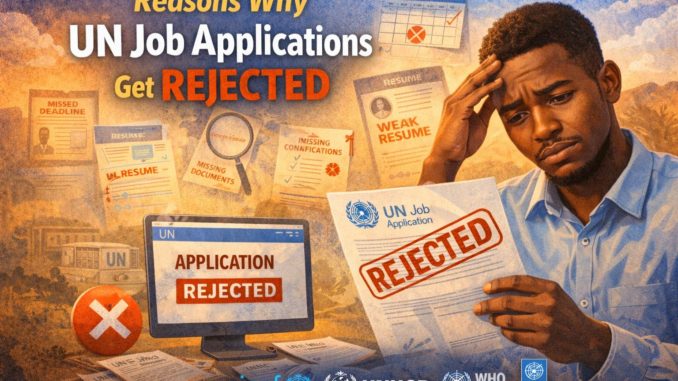
Ever applied for UN jobs in Africa and never heard back? You’re not alone.
Many qualified Africans apply multiple times and still get rejected. This leads to frustration and one big question:
“Why UN job applications get rejected?”
You may start asking yourself:
- Why was I not shortlisted for a UN job?
- Did I miss something?
- Is the process unfair?
- Is it because I am from Africa?
Let’s be honest.
Most times, rejection is not about nationality. It is about strategy.
In this post, we will break down:
Table of Contents
If you truly want to improve your chances, read this carefully.
How UN Shortlisting Process Works
Before we talk about mistakes, you need to understand the UN shortlisting process explained in simple terms.
When you submit an application through the United Nations system:
- HR checks if you meet the minimum requirements.
- Applications are screened for relevant experience.
- Keywords and competencies are matched.
- A shortlist is created.
- Only shortlisted candidates are contacted.
If you’re not shortlisted, it doesn’t mean you are unqualified.
It often means:
- You didn’t show you meet the criteria.
- Your experience wasn’t aligned enough.
- Someone else matched the job description better.
Why UN Applications Get Rejected
Now let’s look at the biggest reasons applicants get rejected.
1. You did not meet the minimum requirements
This is the most common mistake.
If a job requires:
- 2 years of experience
- A specific degree
- Fluency in French
And you do not meet it, HR will automatically disqualify your application.
Many people apply anyway hoping HR will “consider” them.
They will not.
Practical Fix:
- Apply only when you meet at least 80–90% of the requirements.
- Don’t ignore mandatory language requirements.
- Focus on realistic levels like P1, NO-A, or G-level roles.
See Entry-Level UN Jobs in Africa
2. Your CV is too generic
One of the biggest common UN application mistakes is using the same CV for every job.
The UN recruitment system is competency-based.
That means they look for:
- Specific skills
- Clear achievements
- Measurable results
If your CV is generic and not aligned with the job description, you’ll not be shortlisted.
Example of Weak Statement:
“Responsible for project activities.”
Stronger Version:
“Coordinated a community health project serving 2,000 households and improved vaccination coverage by 15%.”
See the difference?
Practical Fix:
- Match your experience to the exact duties listed.
- Use keywords from the job description.
- Quantify your achievements.
Learn How to Tailor Your CV for UN Jobs
3. You didn’t understand UN competency system
The UN doesn’t just hire based on degrees.
They hire competencies such as:
- Teamwork
- Communication
- Planning and organizing
- Accountability
- Client orientation
If your application does not show these competencies, you’ll be rejected.
Many Africans write very short, basic descriptions of their work.
That is not enough.
Practical Fix:
For every job experience, show:
- What you did
- How you did it
- The result
Always include impact.
4. You ignored the Personal History Profile (PHP)
Inside the UN recruitment system, your Personal History Profile (PHP) is very important.
Many applicants:
- Leave sections incomplete
- Copy-paste from CV without adjusting
- Write very short answers
HR often reviews the PHP more than the attached CV.
If your PHP is weak, your chances drop.
Practical Fix:
- Fill every section carefully.
- Avoid one-line answers.
- Be detailed but clear.
Get Step-by-Step Guide to Applying on UN Inspira
5. You applied for the ‘wrong level’
Sometimes rejection is about job level mismatch.
If you’re applying for P3 roles with only 1 year of experience, you will be rejected.
Same way some experienced professionals apply only for very junior roles, which may not align well.
Practical Fix:
Understand the UN grading system.
- P1/P2 = entry-level professional
- G-level = local administrative roles
- NO-A/NO-B = national officer roles
Apply at the right level. See UN Job Levels Explained
6. You applied without relevant experience
Not all experience is equal.
If the job is about Monitoring & Evaluation, but your experience is Sales, HR may not see alignment.
This is one of the most overlooked UN application rejection reasons.
Practical Fix:
Before applying, ask:
- Does my experience clearly match at least 70% of the duties?
- Can I prove this with examples?
If not, consider building more relevant experience first.
7. High competition
Sometimes, you did everything right.
But 500 people applied.
And 20 of them had:
- Master’s degrees
- 3 years of UN experience
- Fluency in two UN languages
Competition is real.
This is why you may wonder:
“Why was I not shortlisted for a UN job even though I qualified?”
Well, someone else may have been slightly stronger.
And that is normal.
Do not take it personally.
8. You applied at random without strategy
Some applicants apply to 30 jobs per month without focus.
That rarely works.
It is better to:
- Choose 1–2 agencies aligned with your background.
- Monitor their vacancies.
- Tailor every application carefully.
Strategic application increases your chances. See the Top UN Agencies Hiring in Africa
How to Improve Your Chances Immediately
Here are practical steps you can take today:
- Focus on realistic job levels.
- Tailor your CV for every application.
- Use measurable achievements.
- Strengthen language skills (especially French).
- Gain volunteer or NGO experience in relevant fields.
- Be patient and consistent.
Rejection is common, even for strong candidates.
Persistence matters.
Frequently Asked Questions (FAQ)
1. Why UN job applications get rejected so often?
2. Why was I not shortlisted for a UN job?
3. What are the most common UN application mistakes?
Submitting a generic CV.
Ignoring competency-based questions.
Leaving the Personal History Profile incomplete
4. Does nationality affect UN shortlisting?
The UN system focuses on qualifications and experience.
However, some positions are limited to nationals of specific countries (National Officer roles).
5. How can I increase my chances of being shortlisted?
Tailor your CV.
Match keywords.
Build relevant experience.
Understand the UN shortlisting process
Conclusion
If you’ve been rejected before, don’t give up.
Many successful UN professionals were rejected multiple times before being hired.
Instead of asking only:
“Why UN job applications get rejected?”
Start asking:
“What can I improve in my next application?”
Small improvements can make a big difference.
Stay focused. Stay strategic. Keep applying the right way.
Leave a Reply