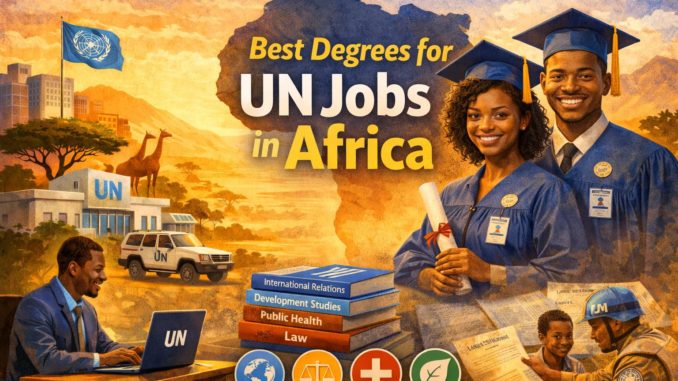
If you want to work with the UN in Africa, there are best degrees for UN jobs to improve your chances?
Many Africans study hard but choose degrees that don’t match real UN hiring needs. Then they struggle to get shortlisted.
Let’s break it down.
Table of Contents
There is No Single “Perfect” Degree
The United Nations system is large.
It includes agencies like:
- UNDP
- UNICEF
- World Food Programme
- UNHCR
Each agency hires for different roles.
So instead of asking:
“What is the best degree?”
Ask:
“What UN job category do I want?”
Your degree must match the job family.
Some Best Degrees for UN Jobs in Africa
Here’s the list.
1. International Development and Development Studies
This is best for:
- Programme Officer
- Policy Analyst
- Development Specialist
An International Development degree is one of the strongest pathways for Africa-focused roles.
Why?
Many UN roles in Africa focus on:
- Poverty reduction
- Governance
- Climate resilience
- Gender equality
- Economic development
UN agencies hiring development graduates include:
- UNDP
- UNICEF
- UN Women
- Regional UN offices
If you want to work in policy, strategy or national development planning, this is one of the best degrees for UN jobs in Africa.
Recommended for Master’s
If possible, pursue:
- MSc in International Development
- Master’s in Public Policy
- Master’s in Development Economics
This significantly increases competitiveness for P2-level roles.
2. Public Health and Global Health
This is best for:
- Health Officer
- Nutrition Specialist
- Emergency Health Coordinator
If you’re interested in public health jobs UN Africa, this degree is very valuable.
Many African countries work closely with:
- UNICEF
- World Health Organization
They hire professionals in:
- Epidemiology
- Nutrition
- Health systems strengthening
- Maternal and child health
Public health is one of the most in-demand UN fields in Africa.
Recommended for Master’s
- Master of Public Health (MPH)
- MSc in Global Health
- MSc in Epidemiology
This are some of the best masters for UN career in Africa.
3. Logistics and Supply Chain Management
This is best for:
- Supply Chain Officer
- Logistics Officer
- Procurement Specialist
Many Africans overlook this.
But agencies like World Food Programme hire heavily in:
- Supply chain
- Warehouse management
- Transport coordination
- Emergency logistics
In humanitarian settings, logistics professionals are critical.
If you enjoy operations and coordination, this is your smartest path.
4. International Law or Human Rights Law
This is best for:
- Protection Officer
- Legal Officer
- Human Rights Officer
Some UN agencies hire law graduates regularly, like:
- UNHCR
- Office of the United Nations High Commissioner for Human Rights
Strong areas include:
- Refugee law
- Human rights law
- International humanitarian law
This path is ideal if you want to work in displacement, protection or refugee response.
5. Economics and Finance
This is best for:
- Economic Analyst
- Budget Officer
- Monitoring & Evaluation Specialist
UN agencies often need experts who understand:
- Macroeconomics
- Public finance
- Impact evaluation
- Data interpretation
Economics is well-respected in the UN system.
If you combine it with data skills, your profile becomes even stronger.
6. Data Science, Statistics and Monitoring & Evaluation
This is best for:
- Data Analyst
- Monitoring & Evaluation Officer
- Research Specialist
Data-driven decisions are growing fast in Africa.
Many development programs now require:
- Impact measurement
- Dashboard creation
- Program evaluation
If you add:
- Power BI
- Python
- Advanced Excel
Your competitiveness increases significantly.
7. Communications and Journalism
This is best for:
- Public Information Officer
- Communications Specialist
Agencies need professionals who can:
- Write reports
- Manage social media
- Create campaigns
- Handle media relations
If you combine communications with development knowledge, you become more attractive to employers.
Summary of Courses Needed to Work in UN
Here is a simple guide linking degrees to UN job categories.
| Degree | UN Job Category | Best Agencies |
| International Development | Programme & Policy | UNDP, UNICEF |
| Public Health | Health & Nutrition | UNICEF, WHO |
| Law | Protection & Human Rights | UNHCR, OHCHR |
| Logistics | Operations & Supply Chain | WFP |
| Economics | Economic Analysis & Budget | UNDP |
| Data Science | Monitoring & Evaluation | Most agencies |
Bachelor’s vs. Master’s: What Matters More?
For entry-level roles:
- Bachelor’s degree may qualify you for internships and assistant roles.
For P2 and professional roles:
- A Master’s degree is often required or strongly preferred.
If your goal is long-term UN employment in Africa, pursuing the best masters for UN career Africa can improve your chances.
Common Mistake of Studying without Strategy
Many applicants choose degrees without researching:
- Actual UN job descriptions
- Minimum requirements
- Required years of experience
Before enrolling in a program, review job listings from your target agency.
Also understand why applications fail.
Planning early saves years of frustration.
Frequently Asked Questions (FAQ)
1. What is the best degree for UN jobs in Africa?
2. Can I work for the UN with only a bachelor’s degree?
3. Is an international development degree good for UN jobs?
4. Which degree is best for public health jobs UN Africa?
5. Does the university ranking matter?
Conclusion
Choosing the best degree for UN jobs is not about prestige, but alignment.
Align your degree with:
- the UN job family you want
- the agency hiring most in your region
- the skills in demand in Africa
Study strategically, build experience early and always tailor your academic path toward real job descriptions.
Leave a Reply