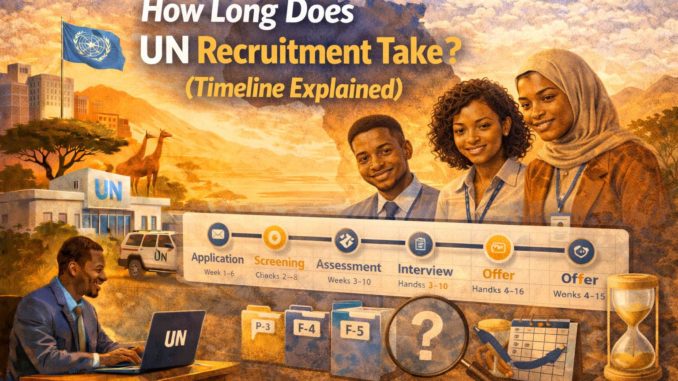
One of the most frustrating parts of applying to the United Nations is the waiting.
If you’re searching for the UN recruitment process timeline, you’re probably wondering:
- Why is my application still “Under Consideration”?
- How long does UN application under consideration last?
- What do UN application status meanings actually mean?
- Why does UN recruitment take so long?
Let’s break it down.
How Long Does UN Recruitment Take?
Typical timeline:
| Stage | Estimated Time |
| Application Deadline Closes | Day 0 |
| Longlisting | 2–6 weeks |
| Shortlisting | 4–8 weeks |
| Written Test / Interview | 1–2 months after deadline |
| Reference Checks | 2–4 weeks |
| Final Selection & Approval | 1–3 months |
| Offer Issued | 3–6+ months total |
Average total process: 3 to 6 months
Sometimes longer (especially for international roles).
Yes, it’s slow.
Why UN Recruitment Takes Long
Several structural reasons:
1. Multiple Review Layers
Applications may pass through:
- HR screening
- Hiring manager
- Panel review
- Compliance checks
2. Large Applicant Pools
Some roles receive:
- 300–1,000+ applications
3. Budget and Approval Cycles
Hiring decisions often require:
- Funding confirmation
- Senior management sign-off
- Headquarters clearance
This makes the process slower than most NGOs.
UN Hiring Process Stages
Understanding the UN hiring process stages reduces anxiety.
1. Application submitted
Status: “Applied”
No review yet.
2. Under consideration
This is the most confusing stage.
“Under Consideration” means:
- You passed initial screening
- Your application is being reviewed
- You are not rejected yet
How long UN application under consideration?
Anywhere from: 2 weeks to 3 months
If it changes quickly, you were not longlisted.
3. Longlisting
Longlist means Qualified candidates.
Not yet shortlisted.
This phase filters for:
- Minimum education
- Required years of experience
- Language requirements
4. Shortlisting
Now competition narrows significantly.
Usually: 5 to 10 candidates remain.
You may receive:
- Written test invitation
- Interview invitation
For preparation, read: UN Competency-Based Interview Questions
5. Interview and Assessment
Most UN interviews are:
- Panel-based
- Competency-focused
- Structured scoring
The UN often uses behavioral questions.
6. Reference Checks
If references are contacted, that’s a strong sign.
It does NOT guarantee selection, but it means you are a top candidate.
7. Final Review and Offer
Even after selection, approvals may take weeks.
Especially for:
- International P-level roles
- Field missions
- Hardship duty stations
UN Field Jobs vs Headquarters Jobs
UN Application Status Meanings
Here’s what common statuses mean:
| Status | Meaning |
| Applied | Received but not screened |
| Under Consideration | Passed initial screening |
| Shortlisted | Advanced to next stage |
| Rostered | Placed in candidate pool |
| Not Selected | Process concluded |
If you see “Not Selected,” the recruitment is closed.
For improving future applications, read:
How to Tailor Your CV for UN Jobs in Africa
Does Timeline Differ by Role Type?
Yes.
National Officer roles
Usually faster (2–4 months).
Consultancy Roles
Often quicker (1–3 months).
International P-Level roles
Can take 6+ months.
More approvals required.
Why Some Applications Stay “Under Consideration” for Months
Common reasons:
- Position frozen
- Budget reallocated
- Internal candidate prioritized
- Hiring manager delayed
Sometimes the vacancy remains open in the system even after decision is made.
This is normal in large bureaucratic systems.
What You Should Do While Waiting
Do NOT:
- Wait for one application outcome
- Stop applying
- Assume silence means rejection
Instead:
- Apply to 5–10 relevant roles
- Track deadlines
- Prepare interview stories
- Continue skill development
Realistic Expectation Setting
UN recruitment is not fast.
It is structured, competitive and multi-layered.
If you apply in January, you may hear back in April or June.
Patience and consistency matter.
Conclusion
Average: 3–6 months
Can be shorter for consultancy roles.
Can be longer for international positions.
The delay is often structural, not personal.
If you understand the timeline, you can manage your expectations and strategy better.
Leave a Reply