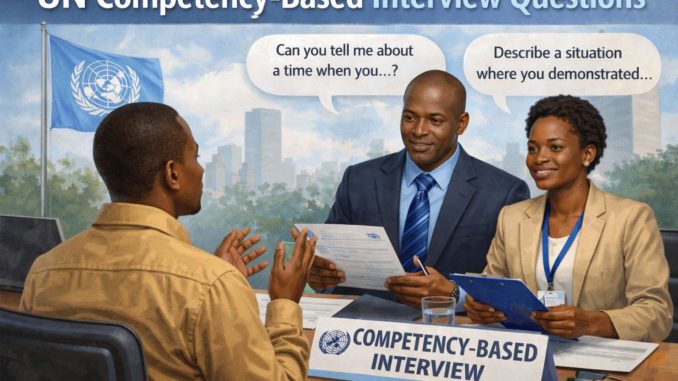
The UN doesn’t conduct casual interviews, they use structured, competency-based assessments.
If you’re searching for UN competency based interview questions, this guide will show you:
- How UN panel interviews actually work
- The STAR method UN interview format
- Real UN behavioural interview examples
- How to pass UN panel interview successfully
- Sample answers you can model
This is where most candidates fail, let’s fix that for you.
How are UN Interviews Structured?
UN interviews are:
- Panel-based (3–5 members)
- Competency-focused.
- Standardized (same questions for all candidates).
- Scored individually by panelists
The questions are not random.
They are based on the job description, required competencies and functional skills.
Because the interview questions come from the competencies listed in the vacancy.
If you haven’t read it yet, review your preparation using: How To Tailor Your CV for UN Jobs in Africa
What is a UN Competency Based Interview?
Instead of asking:
“Why do you want this job?”
They ask:
“Describe a time when you managed competing priorities under tight deadlines.”
They want evidence from your past behaviour, not opinions.
This is where the STAR method UN interview technique becomes critical.
The STAR Method UN Interviews
STAR stands for:
- Situation
- Task
- Action
- Result
Your answers must follow this structure.
Weak answer:
“I’m good at teamwork. I always collaborate.”
Strong answer using STAR:
- Situation: During a regional education programme rollout across 3 states…
- Task: I was responsible for coordinating stakeholder engagement.
- Action: I organized biweekly coordination meetings and created shared reporting templates.
- Result: We reduced reporting delays by 40% and met donor deadlines.
UN scores clear, structured and measurable impact.
Common UN Competency Based Interview Questions
Below are realistic examples used in P-level and NO-level interviews.
1. Teamwork
Question:
“Describe a time when you worked in a diverse team to achieve a common goal.”
Sample Answer Framework:
- Situation: Multi-agency humanitarian response
- Task: Coordination between government and NGO partners
- Action: Created shared communication platform + scheduled weekly syncs
- Result: Improved coordination efficiency and avoided duplication of services
Ensure to highlight cross-cultural collaboration, especially in African multi-stakeholder contexts.
2. Planning and Organizing
Question:
“Tell us about a time you managed multiple deadlines.”
Strong Angle:
- Prioritization strategy
- Delegation
- Risk mitigation
- Quantifiable outcome
Avoid vague responses like “I worked hard.”
3. Communication
Question:
“Describe a time you presented complex information to non-technical stakeholders.”
Good response elements:
- Audience type
- Simplification strategy
- Tools used
- Measurable understanding improvement
4. Leadership
Question:
“Describe a time you led an initiative.”
Even if you weren’t a manager, leadership can mean:
- Coordinating volunteers
- Leading a workshop
- Managing a project component
UN leadership goes beyond the job title.
5. Dealing with conflict
Question:
“Tell us about a time you handled conflict within a team.”
Key scoring factors:
- Emotional intelligence
- Neutral facilitation
- Structured resolution
- Outcome stability
How to Pass UN Panel Interview
Wondering how to pass UN panel interview, focus on these 7 rules:
- Always use STAR
- Be concise (2–3 minutes per answer)
- Use measurable results
- Mention stakeholders
- Show alignment with UN values
- Stay structured under pressure
- Do not memorize scripts — practice frameworks
Panel members score independently.
Clarity beats charisma.
Difference Between UN Behavioural Interview and Private Sector Interview
| UN Interview | Private Sector Interview |
| Highly structured | More conversational |
| Competency scored | Personality assessed |
| Panel format | Often 1–2 interviewers |
| Evidence required | Potential assessed |
This is why strong private-sector candidates sometimes fail UN interviews.
Advanced Tip: Anticipate Questions From the Vacancy
Go back to the job posting.
If it lists competencies like accountability, client orientation, teamwork, planning and organizing.
Prepare one STAR story for each.
Need help understanding job categories, review: UN Job Levels Explained
Special Advice for African Candidates
Many African professionals under-sell their achievements.
Do NOT say: “I just supported”.
Instead say: “I contributed to implementation of a $1.5M governance programme reaching 5,000 beneficiaries across two regions”.
Always quantify.
Typical UN Panel Interview Flow
- Introduction
- 5–8 competency questions
- Technical question(s)
- Scenario-based question
- Your questions
Interviews last 45–90 minutes.
Silence while they take notes is normal, so do not panic.
Technical Question Preparation
Besides behavioural questions, expect:
- Policy knowledge
- Data interpretation
- Scenario response
- Problem-solving case
If applying for NO roles, see UN National Officer Jobs Africa Guide because technical depth varies by level.
Sample UN Behavioural Interview Example
Question:
“Describe a time you improved efficiency in a programme.”
Answer:
- Situation: During implementation of a youth employment project funded by international donors…
- Task: Reporting timelines were frequently delayed across 4 field offices.
- Action: I developed a standardized reporting template and trained focal points on submission protocols.
- Result: Reporting turnaround time decreased by 35%, and donor compliance ratings improved.
Notice the clear structure, measurable impact and demonstrated initiative?
That’s how you score high.
Can I Get UN Interview Questions and Answers PDF?
While templates help, memorizing answers from UN interview questions and answers PDF is risky.
Instead:
Build a bank of 8–10 STAR stories covering:
- Leadership
- Teamwork
- Planning
- Conflict resolution
- Communication
- Technical competence
- Stakeholder engagement
- Results delivery
Then adapt them live.
That’s the professional approach.
Common Interview Mistakes
Speaking without structure
Giving general opinions
Not answering the exact question
No measurable outcomes
Running over time
Remember that panelists are scoring you on predefined criteria.
Conclusion
If you’ve reached interview stage, you are already competitive.
Now the key is mastering:
- UN competency based interview questions
- STAR method UN interview structure
- Clear measurable examples
- Calm panel delivery
Preparation at this stage increases conversion.
Leave a Reply